

316 UCB, 80309-0316
ATLAS Center 329 303-492-7574 303-492-1362

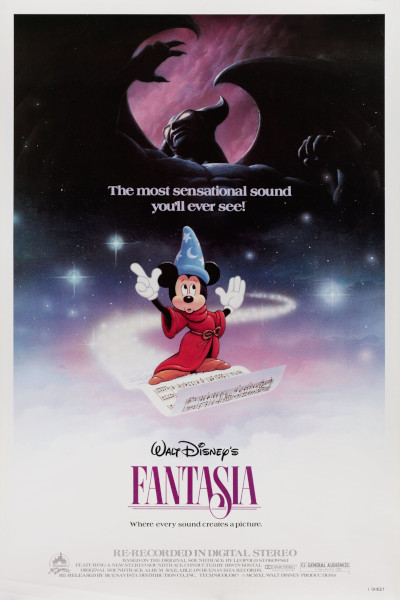
Music critic, radio personality, and composer Deems Taylor introduces "Fantasia" with a lengthy speech about what is to come: an animated visual interpretation by highly skilled artists of what might appear in the minds of audiences as they listen to famous musical selections. He appears between each segment to explain what is arriving next, which is sadly the only dragging, purely unnecessary element in the film (although at the time of its original release, his presence was arguably important to those unaware of what Disney was trying to accomplish). He introduces the conductor of the Philadelphia Orchestra, Leopold Stokowski, who begins with Bach's "Toccata and Fugue in D Minor" as bright lights and vivid colors highlight musicians and silhouettes playing against the perimeters of the stage. Within a few minutes, perfectly synchronized, impressionistic imagery appears inside the backdrop of clouds, while violin strings pierce the sky like raindrops. Shadows roll over hills, abstract structures surf through the air, and fireworks explode over the heavens.
Selections from Tchaikovsky's "The Nutcracker" ballet comprise the music for the following sequence, where nude fairies dance sprightly, sprinkle pixie dust, and cast water droplets over complex spider webs. During "Dance of the Sugar Plum Fairies," "Russian Dance," "Waltz of the Flowers" and more, wonderfully complimentary characters like Asian mushrooms, flowers, and fish perform to the tune of the music. The piece ends with a return to the forest of winged fays as they change the flora from summer to fall to winter, skating across the ice as snowflakes swirl around them.
The third segment, "The Sorcerer's Apprentice" (Paul Dukas' symphonic poem from Goethe's ballad "Der Zauberlehrling"), is the most celebrated of the assemblage, featuring Mickey Mouse as a wizard-in-training. His master, Yen Sid, leaves his magical hat unattended, allowing the curious mouse to conduct a little magic of his own. It goes terribly wrong when Mickey has a broom come alive to carry water for him, resulting in an army of uncontrollable minions submerging the stone dwelling with a whirlpool flood. Unlike the other sections, "The Sorcerer's Apprentice" most resembles an individual short cartoon, as opposed to a transitional skit for a larger whole. It's also the tale that best utilizes its music to narrate the adventure. Next up is Igor Stravinsky's "The Rite of Spring," a pageant showcasing the growth of life on earth, from a volcanic opera of transformation to the first single-cell living creatures to the reign and extinction of dinosaurs (culminating in a terrifying showdown between a stegosaurus and a T-Rex).
After an intermission (for the original roadshow presentation) and a demonstration of how sound can be animated, "The Pastoral Symphony" begins, featuring pastel-colored, swan-like flying horses and their offspring playing in a lake, neighboring on a forest inhabited by more mythical creatures – centaurs, fauns, and cherubs. Female half human-half horse creatures are groomed by chubby-cheeked cupids to prepare for the male centaurs to woo them. This Greek-themed segment also, hilariously, involves the plump Bacchus (the god of wine) drunkenly chasing girls and then frantically dodging lightning bolts as Zeus unsportingly brings a thundering downpour upon the celebration.
Following that is "Dance of the Hours," a ballet from the opera "La Gioconda," comically presented here with ostrich ballerinas led by Madame Upanova, Hyacinth Hippo with her servants, and finally Elephanchine and her troupe of bubble-blowing pachyderms. As each group of dancers appear, representing morning, afternoon, and evening, they become less believably graceful and more enormous, defying gravity yet still clothed in bows, tutus, and slippers. This sequence brilliantly demonstrates the animators' ability to utilize physical humor, slapstick, and fluid rhythm with the operatic selection.
"Fantasia" ends with the unforgettable and morbid "Night on Bald Mountain" (Bald Mountain being the gathering place of Satan and his followers), in which Chernabog summons spirits from a graveyard that he can hurl into pits of flames on the mountainside. The very contrasting "Ave Maria" by Franz Schubert follows this, which forces the devil back into a motionless perch on the mountain for the bright, hopeful dawn of a new day. It's the only segment that contains lyrics.
The arrangement of music alone is inspiring, but it's the seamless combination with traditionally animated mini stories that sets "Fantasia" apart as one of the most tremendous, significant works of visual art. The notes are made more dramatic and the symphonies more powerful; many of the pieces will forever be associated with Disney's designs. Although some music critics may have denounced the combination (which also bored many children) during the original theatrical releases throughout the 1940s, this timeless, imaginative, artistic collaboration is sensational entertainment. It is truly one-of-a-kind, even though an adequate sequel-of-sorts would premiere 59 years later.
— Mike Massie, Gone with the TwinsFri March 27, 7:30 PM, Muenzinger Auditorium
United States of America, 1940, in English, 124 min • official site
Director: Wilfred Jackson, Bill Roberts, Paul Satterfield, Samuel Armstrong, Jim Handley, T. Hee, Hamilton Luske, Ben Sharpsteen, James Algar, Norman Ferguson, David Hand, Story: Dick Huemer, Joe Grant, Director: Ford Beebe Jr., Cast: Deems Taylor
