

316 UCB, 80309-0316
ATLAS Center 329 303-492-7574 303-492-1362

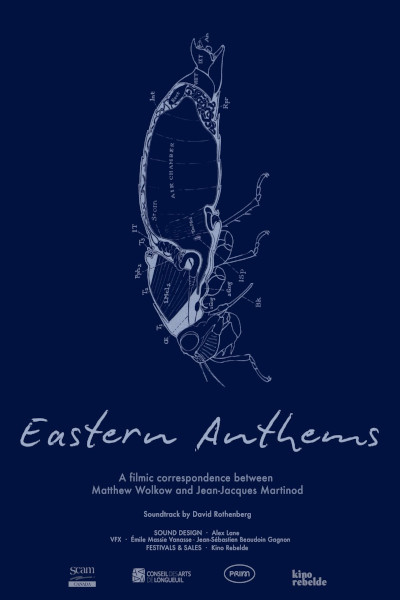
In 2021, the cicada Brood X, which hatches every 17 years in the eastern United States, was about to return. Matthew Wolkow was preparing for his first feature film to cover this event. But the COVID-19 pandemic and the travel restrictions that accompanied the lockdowns have derailed this project. Eastern Anthems, in gestation for five years, had to adapt to the last minute. Living in Montreal, Wolkow contacted Jean-Jacques Martinod, across the border, to help him. Threatened with eviction after a rent increase in Santa Fe, Martinod also had to adapt to an unexpected change. Then begins a correspondence between the two men who wish to capture the appearance of Brood X while the United States emerges from the gloomy first principal of Donald Trump and the Black Lives Matter movement still remains vivid in the minds. Wolkow and Martinod offer us a sensitive film that, through a formal work that gives pride of place to the trial and fragility of art, gives us to see a world in the grip of trouble where cicadas seem to predict the end of an era while another is still slow to arrive.
Wolkow (Peacock Monologues, 2020) is a regular in movies that take the detour of an animal or insect to talk about humans, its relationship to nature and how it can become a vector of social connection. In Eastern Anthems and through his collaboration with Martinod, this approach is taken further. Brood X becomes the grid through which the two filmmakers observe a world in transformation. The cicada in cyclical existence is introduced to us through radio programs, broadcast in a car gradually moving away from the city. The interventions selected speak alarmingly of millions, even billions of red-eyed creatures that overnight will invade the American sound space of their squeal. Jazz music with a syncopated rhythm, which accompanies this editing, accentuates an impression of ambient chaos. The cicadas even caused an accident when they entered the cabin of a car. Halfway between science fiction and the paranoid cinema of the 1970's, the opening of Eastern Anthems gives the impression of a troubled world where the media is a perverted source of information that negatively influences our representations. This sense of urgency echoes the political and social situation of the United States in 2021, as if the closed borders favored a withdrawal and fear of the other.
The concrete effects of the pandemic situation are embodied in the process of bicephalic creation of the film. Accompanied by a Bolex and a stock of expired film, Martinod takes care of the images in the United States while Wolkow takes care of interviews and editing remotely. The beautiful bright colors, the marked grain and the twilight of the film immediately detonate. These imperfections, more than a whim of aesthetes, appear in tune with a project that celebrates DIY in cinema. It also remains to be emphasized the incongruity of carrying out such a project on film today. At the time of the digital event, any documentary can afford to film an unlimited amount of material, even if it means sorting once on the virtual editing benches. By the logistical burden it implies and the limit in the filmable duration it imposes, the film forces the directors to carefully select the real to be captured. Martinod and Wolkow position themselves from the outset in a humble ecology of the image that rejects a certain predation of the living in favor of a desire to sublimate it by treating it with delicacy.
Despite their adjustments to the situation, the two filmmakers were not at the end of their pain. During a shoot at a gathering of Brood X aficionados, the Bolex charger broke. The damaged mechanism resulted in an irregularity in the scrolling of the film while destroying much of the plans already turned. This accident will further reduce the amount of images available and force both directors to adapt again. In addition, extracts from video games, television and sequences inspired by experimental cinema will be added. If documentary cinema is often made of unforeseen events, we must salute the sensitivity and maturity with which Wolkow and Martinod have been able to seize all the adventures to make it a stroke of luck rather than a curse. The additional assembly work induced by this break is also an opportunity to strengthen the division, in fact central, between the images of Martinod and the sound and visual editing of Wolkow. The sound of the cicadas becomes an integral part of the film thanks to a thorough work in stereo. The different frequencies that insects emit, far from being a nuisance, have been put forward to make the richness of the soundscape they develop heard. This work will reach its peak during a musical sequence where a clarinetist performs in duet with the cicadas a piece of music, the latter reacting to the notes played.
Beyond their aesthetic work, Wolkow and Martinod demonstrate through their stagings a singular relationship to nature and the insect that allows the film to rise beyond the self-reflexive film or the simple report on a curiosity of entomologist. Eastern Anthems is a salutary call to find a relationship to the more harmonious, but also less idealistic, living. Treating nature with respect also involves considering it in its violence and sometimes in its cruelty – like those billions of cicadas that are born and die almost at the same time and that make their natural predators happy. In this the film can make us think of Werner Herzog who, in Burden of Dreams (The Blank, 1982), spoke of the jungle in these terms: "We must be humble in the face of this overwhelming misery, this overwhelming fornication, this dazzling growth, this overwhelming lack of order. There is no harmony in the universe. [...] But when I say that, I say it with admiration for the jungle. It's not that I hate her. I love him. I love him very much. I love him against my best judgment.
— Alexandre Ruffier, 24 imagesSat April 18, 7:30 PM, Muenzinger Auditorium
Canada, United States of America, Ecuador; 2024; in English, French, Spanish; 76 min
Director: Jean-Jacques Martinod, Matthew Wolkow
